
CUSTOM PROJECT MANAGEMENT TRAINING FOR TEAMS
Training built around what your team has to deliver.
Running projects is a leadership skill, with or without a PM title. We define the outcome first, build the training around your team, and come back at 90 days to measure the results.
Design | Deliver | 90-day review | Virtual, On-Site, or Hybrid | PDU-eligible
20+ Yrs Program Leadership | Class III Med Device | Nuclear | Aerospace | PMP Certified
What this PM support actually looks like
90 seconds on who this is for, what little risk you have in proceeding, and how we get started.
WHO IT'S FOR
PM by title or expert by necessity. Training built for the team you have.
Everyone needs the capability, not everyone needs to be the specialist. Grounded in PMI practice, then cut down to the few methods that matter most for your company.
YOU HAVE PROJECT MANAGERS
Your PMs know the framework. They need the right parts, sharper.
PMI methodology is vast. A few high-impact things, done right, start a snowball of success Often that means:
Scheduling accurately and speaking in levels of confidence
Stakeholder management that's rooted in good leadership
Earned value at the right level, before it becomes a full-time job
Budget depth that matches who actually owns the budget
Approaches defined so the 'why' is understood
YOUR EXPERTS RUN THE PROJECTS
Many companies are better without a full-time PM. The right skills still have a big impact.
Engineers, marketers, operations leads: experts who run projects on top of their day job. Planning, dependencies, and risk are a part of leading. Some fundamentals that can deliver include:
Defining scope and what done looks like
Scheduling with confidence and the levers to accelerate
Spotting risks that matter, and what to do about them
Leadership tools that give an expert the confidence to lead
Techniques for team motivation, and what good accountability looks like
HOW IT WORKS
Start with the outcome. End with proof it gets delivered.
1 DESIGN
Program Design Engagement
We meet with your stakeholders and project teams. We agree on the outcome the training has to deliver and how we'll measure it, and then map where execution breaks today.
You get: a written program design with the target outcome, measures, and the training plan.
2 DELIVER
Custom Training Cohort
4-6 weeks of working sessions built from the design. Your people apply each piece to their own live projects, with coaching between sessions. Up to 20 per cohort.
Add-on: Leadership Lab, a day that maps each person's leadership style and works influence without authority.
3 REVIEW
90-Day Delivery Review
Ninety days after the last session, we come back. We measure against the outcome we set in the design: what's working, what isn't, and what to adjust.
You get: a written review against the target, and clear next steps.
PROOF
What participants and peers say.
From cohorts of Project Management Fundamentals, co-taught by Jim and Col. Tom Magness at Abiomed, and PMI Mass Bay leadership speaker event.
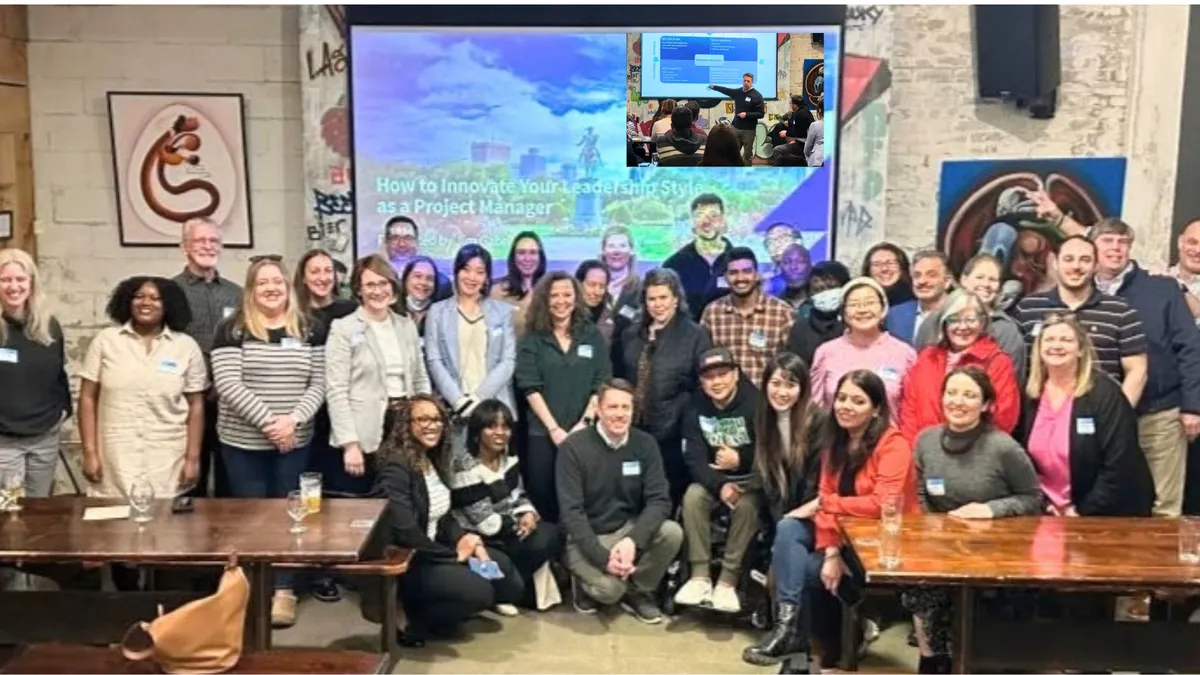
PMI MASS BAY CHAPTER | INVITED SPEAKER
How to Innovate Your Leadership Style as a Project Manager
"Jim Gabriel delivered a clear and practical perspective on leading through ambiguity... leadership confidence is not something you 'have', but something you build through clarity, structure, and intentional decision-making."
Carrie H., Program Manager, PMI Mass Bay event team
What A PARTICIPANT ASKED LEADERSHIP FOR
"Please ensure this training is standardized across the business, including for Japan, Germany, and Baltimore. You will see this pay off with dividends if this is done."
Participant, Project Management Fundamentals at Abiomed
THE OUTCOME IS YOURS
Which of these sounds like your team?
The program gets built on PMI's seven performance domains, with detailed workshop portions selected, plus the leadership that makes them stick. In the design engagement we define what matters most, then measure them at 90 days.
"Every task is padded. The project is still late."
SCHEDULE
→ Pull the padding out of tasks and pool it where it protects the finish date.
Critical Chain
90-day measure: buffer burn vs. progress
"Everyone is on five projects. Nothing finishes."
SCHEDULE
→ Leaders make the priority calls so teams can limit work in progress.
Theory of Constraints
90-day measure: projects finished per Qtr
"Departments are winning. The business is losing."
RESOURCES
→ Leads put the business and the project team first and their function second.
Lencioni's first team
90-day measure: cross-team decision closure
"Decision made Tuesday. Reopened Thursday."
GOVERNANCE
→ Debate openly, decide once, commit as a team.
Disagree and commit
90-day measure: decisions reopened per month
"Every request gets a yes."
SCOPE
→ Weigh each change against date, cost and goal, and give a clear no when it's needed.
Radical Candor
90-day measure: unplanned changes absorbed
"Earned value became a full-time job."
FINANCE
→ Cost tracking at the level the business actually uses, so PMs get back to leading.
Situational leadership
90-day measure: hours on cost reporting or human dependancy lag
"A key voice shows up late and derails it."
STAKEHOLDERS
→ Know what each stakeholder needs before they have to say it.
Emotional intelligence
90-day measure: late-stage objections
"Meetings eat the week with no real action"
STAKEHOLDERS
→ One purpose per meeting, and people speak up in the room.
Death by Meeting
90-day measure: meeting hours per person
"Bad news travels slowly. Setbacks last for months."
RISK
→ Problems surfaced fast, owned, and learned from.
After-action reviews
90-day measure: time to recover
Recognize any? That's worth a 30-minute conversation.

WHO TEACHES IT
Jim Gabriel, PMP
Two decades running programs in high-stakes environments: nuclear power generation, aerospace, commercial architectural specialty and medical devices. As Associate Director of R&D at Abiomed / J&J, I led a team of engineers and ran programs that brought multiple Class III devices to market.
I've designed and delivered tailored training for more than five years and speak on project leadership for PMI. Today I also run programs for high-stakes companies as a fractional program leader, so what I teach is what I use.
BS Industrial & Manufacturing Engineering | MS Engineering Management | PMP since 2012
GOOD TO KNOW
Questions buyers ask
We have a PMO. Is this for us?
Yes. We build on the PMI practice your PMs already know and focus on the few methods your business needs most. Sometimes removing one over-constraint, or nudging the focus into alignment, is what lifts the PMO's value to the organization.
What happens at 90 days?
We re-engage and measure against the outcome we set at the start. You see what stuck and what needs adjusting.
Can it fit our QMS and phase-gate process?
That's the point. We work inside your process and your live projects.
On-site or virtual?
Either. On-site in New England is easy. Elsewhere, travel is reimbursed at cost. Hybrid tends to provide a good balance, which is also an option.
We don't have PMs. Is this for us?
Yes. Your engineers, marketers or ops leads get the fundamentals they need to run projects well. No certification required.
Is this PMP exam prep?
No. It's about delivering your projects. Certified participants can self-report the hours as PDUs.
Who should attend?
Whoever leads projects: PMs, engineers, marketers, technical and ops leads, plus the functional leads who feed the schedule. It's also valuable for key stakeholders to participate in some portion.

Let's discuss what your team has to deliver.
Thirty minutes on your actual projects. If this isn't the right fit, at least you'll leave with a few good questions.


© 2026 Archangel Operations LLC | Privacy Policy | Terms